







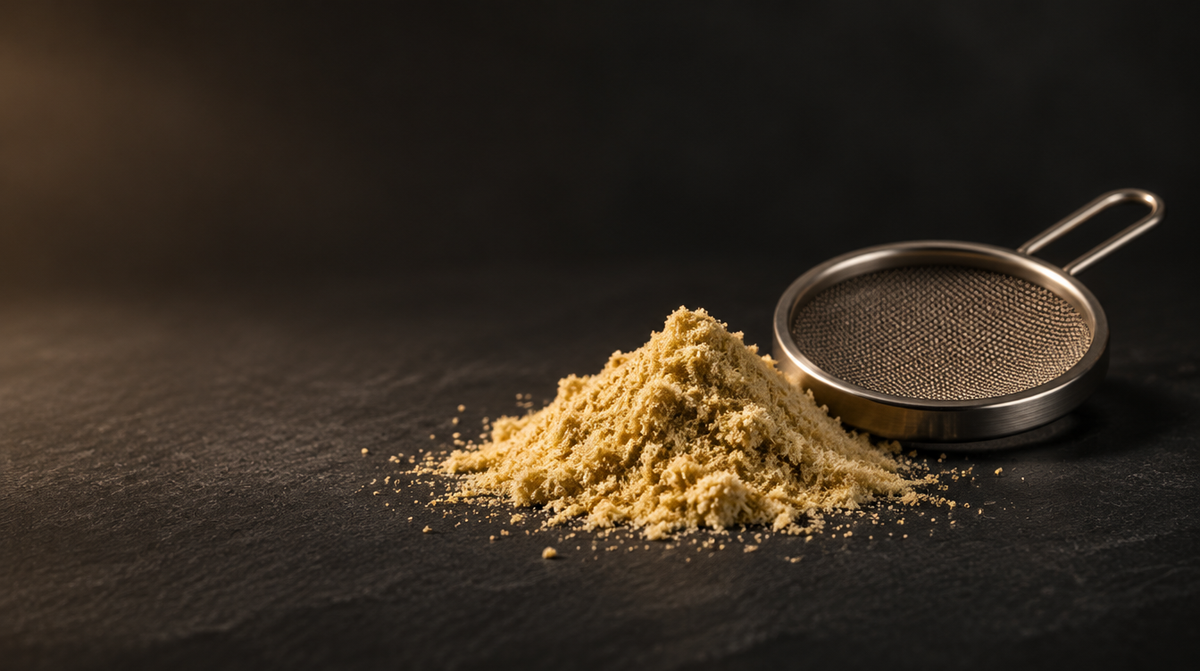
Two packets of dry sift hash can look almost identical and still differ sharply in purity, because everything depends on the screen the powder last passed through. Dry sift is resin separated from dried cannabis or hemp over fine mesh, with no water, no ice and no solvent involved. What passes the mesh is a sandy powder of trichome heads, which can be left loose or pressed into a slab. The name describes the separation method, not a strain and not a cannabinoid.
Most questions about it are about how it differs from the kief in a grinder, what the micron numbers on a grade mean, and how much of the final weight is actual resin.
What is dry sift hash
Dry sift hash is a mechanical concentrate made only of the glandular resin heads that sit on the surface of the flower. Those heads, the capitate-stalked trichomes, hold almost all of the cannabinoids and most of the aromatic terpenes the plant produces. When the plant material is dry and cool, the heads become brittle and detach from the stalk under gentle agitation. Everything that is not resin, so leaf fragments, stalk pieces and fibre, is retained by the screen or remains in the coarser fractions.
The colour shows what passed through. A clean pull is blond to light sand coloured. Green tones indicate that plant matter passed the screen as well. Dark brown usually points to oxidation, pressure or heat after sieving. Texture matters as well: a high grade is fine and free-flowing, and it clumps only when warmed between the fingers, while a coarser grade feels gritty and shows visible green specks. Canapuff sells the result as loose material under hash, where the sifted styles sit next to pressed and water-extracted ones.
How dry sift is made, in short
Dry sift is produced by moving dried flower across stacked screens of decreasing mesh size, so that resin heads pass the mesh and plant debris remains above it. At small scale this happens on hand-held sieve boxes. At production scale, rotating drums or vibrating tables perform the same work with more consistency, because the agitation stays even and the material never warms. No water touches the plant, no butane, ethanol or CO2 is used and nothing is added afterwards, which is why the category is called solventless.
Each screen in the stack retains a different particle size. The first screens remove the obvious plant fragments. The later, finer ones hold back everything larger than a resin gland and let only the smallest particles through. The number of passes decides the purity, and every pass costs yield.
Dry sift micron grades explained
A micron grade is simply the opening size of the last screen the material passed, measured in micrometres, one thousandth of a millimetre. Resin heads are small enough to pass through fine mesh, while leaf fragments, stalk pieces and trichome stems are mostly larger and stay behind. Grading rests on that size gap: the finer the final screen, the less besides resin gets through.

- Coarse screens, the widest mesh used: resin heads arrive together with leaf fragments and stalk pieces. Green tinted, aromatic, visibly impure, often re-sifted rather than sold as a grade.
- Medium screens, a mid-range mesh: most of the larger plant debris stays above the mesh. The powder is lighter in colour and the resin share rises.
- Fine screens, a finer mesh still: close to the diameter of a large resin head, so little besides resin passes. Producers often describe material from these screens as full melt, though the term is not a measured standard.
- The finest pull, from the tightest mesh: the purest fraction by proportion of resin to plant matter, because almost nothing bulkier than a gland fits through the opening. Pale, powdery and the smallest in yield.
Grade numbers are set by each producer, so a figure printed on a package tells you which screen was used, not how many times the material was refined. Two products labelled with the same micron grade can differ sharply if one was sifted once and the other several times. The visible test is the same in both cases: hold the powder against white paper and look for green.


Dry sift vs kief: what actually changes
Kief is the unsorted resin dust that collects under the screen of a grinder, and dry sift is that same material after it has been sieved and graded. A three-chamber grinder has one fixed mesh, often fairly coarse, and it collects whatever passes while you grind the flower. Nobody separates the fractions afterwards, so the result mixes whole heads, broken heads and leaf dust in one pile.
Dry sift uses the same raw starting point and adds selection. The grading step is the entire difference in purity, aroma and melt behaviour. Side by side on a sheet of glass, grinder kief looks olive and a fine sift looks blond. Our article on what kief is covers the grinder side of this in more detail.
Dry sift vs frozen hash
Frozen hash separates the resin in ice water, while dry sift separates it on dry screens. In the ice water route, flower is agitated in freezing water so the brittle resin heads detach and sink into a series of filter bags. The collected material is wet and has to be dried carefully before it can be stored, and that drying decides much of its quality. Our guide to frozen hash and live rosin describes that process.
Dry sift omits the water stage entirely. There is no drying step, no risk of microbial growth from residual moisture and no leaching of water-soluble compounds. The trade-off is that dry sieving cannot remove contaminants that water would carry away, so the cleanliness of the starting flower limits the quality of the finished powder.
Dry sift vs static and piatella hash
Static hash is a refinement of dry sifting, and piatella is a storage and curing style rather than a separation method. In static separation, an electrically charged surface separates the lighter plant debris from the heavier resin heads, which produces a very pale powder without any additional screening. The principle is covered in our piece on static hash.
Piatella starts from hashish that is pressed under weight and then cured for weeks in sealed conditions, which turns the texture glossy and darkens the colour. A sift can become a piatella after pressing and curing, while a piatella cannot return to loose powder. Our explainer on piatella hash describes what the curing does to aroma.
Dry sift hash cannabinoid content
Sifting concentrates what the flower already contained, so the cannabinoid content of a dry sift is a multiple of the input material rather than a fixed number. Nothing is added and nothing is converted, which is why a sift from CBD-rich hemp stays CBD-rich and a sift from a THC-rich plant stays THC-rich. The grade matters too: a fraction full of intact heads carries more resin per gram than a coarse fraction diluted with leaf particles.

Canapuff Dry Sift Hash is produced from EU-certified hemp, is rich in CBD and is made without solvents. Every batch comes with a certificate of analysis for its THC content. Pressed CBD styles such as those in the CBD hash collection may list their cannabinoid content on the product page, a reference point for how far hemp resin can be concentrated.
On the legal side, the threshold of 0.3 percent THC applies to industrial hemp varieties grown in the European Union, as summarised by the European Commission hemp pages. The rules for finished hemp products are set nationally and differ widely between countries, so check what applies where you live.
How to store dry sift so it keeps its aroma
Loose sift has a very large surface area for its weight, which makes it more exposed to oxygen, light and warmth than a pressed slab of the same material. Terpenes evaporate first and the aroma fades within weeks if the powder sits in a half-empty container on a windowsill. Cannabinoids oxidise more slowly, but light and heat accelerate that process too. Keep it cool, dark and airtight. Glass preserves aroma better than thin plastic because it does not absorb aroma compounds.
Temperature swings cause a second problem. Warm sift softens, forms clumps and loses its free-flowing texture permanently, which amounts to an unplanned press. Keeping the container away from radiators, car interiors and direct sun prevents most of that.
Loose sift accumulates a static charge and adheres to plastic walls and lids. A small glass jar with a metal lid keeps more of the powder reachable than a plastic tub.
Container size counts as well: a jar that is almost full holds less air against the powder than the same weight spread across a large tin. Both the loose grades and the pressed plates are listed together in the hash collection, with the certificate details on each product page.