








Table of contents
- What are Delta 9 edibles ›
- Is Delta 9 the same as THC ›
- Where the name Delta 9 edibles comes from ›
- Types of Delta 9 edibles ›
- How long do Delta 9 edibles take to kick in ›
- How long do Delta 9 edibles last ›
- Why the effects of Delta 9 edibles vary ›
- Delta 9 edibles in Germany: the legal situation ›
- Do Delta 9 edibles show up on a drug test ›
Delta 9 edibles are foods such as gummies, chocolate, cookies and brownies that contain delta-9-tetrahydrocannabinol, the same THC that is found in cannabis flowers. Their effects start later than with smoking, usually after 30 to 90 minutes, and last longer, about 4 to 12 hours depending on the amount. "Delta 9" is not a new substance but the chemical name of ordinary THC, and the label mostly comes from the US hemp market.
In Germany, edibles with THC are not covered by the cannabis law of 2024, and hemp products are subject to their own limits. The sections below explain what the term means, how the products work, why the effects vary so much and what the rules say, as of November 2026.
Key facts
- Delta 9 THC, D9 and Δ9-THC are names for the same molecule: the main psychoactive cannabinoid of cannabis.
- Onset after eating: about 30 to 90 minutes. Strongest effect after 2 to 3 hours.
- Duration: about 4 to 12 hours, depending on the amount and the person.
- Germany: according to the Federal Ministry of Health, THC edibles are not permitted under the KCanG of 1 April 2024.
What are Delta 9 edibles
Delta 9 edibles are food products with a defined amount of THC per piece, sold mostly as gummies, chocolate, baked goods and candies. The THC is usually added as an extract or distillate to the mass before portioning, so that every piece should contain the same amount. The label states the cannabinoid and the amount in milligrams per piece or per pack. Unlike flowers or vapes, nothing is heated or inhaled: the THC is taken up through the digestive tract.
The term is used for two very different product groups. In US states with a regulated cannabis market, "Delta 9 edibles" are often products made from cannabis with high THC content. On the hemp market, the same term describes products made from hemp, in which the THC content per gram of product stays below a legal threshold, but the absolute amount per piece can still be noticeable. If you want to understand how to read the label of such products, our THC edibles buying guide explains the terms on the packaging.
Is Delta 9 the same as THC
Yes: Delta 9 THC is the THC that people mean when they talk about cannabis, and "Delta 9" only describes where a double bond sits in the molecule. The full name is delta-9-tetrahydrocannabinol, abbreviated Δ9-THC or D9. Other forms of THC differ in this detail:
- Delta 8 THC has the double bond at a different position. It occurs naturally only in traces and is mostly made from CBD. The differences are covered in Delta 8 vs Delta 9.
- THCA is the acid form that the plant actually produces. It turns into Delta 9 THC when heated. For edibles, manufacturers therefore use THC that has already been activated.
- 11-hydroxy-THC is not a product but a metabolite that the liver makes from Delta 9 THC after eating. It plays a central role in why edibles feel different, see our article on 11-hydroxy-THC.
Where the name Delta 9 edibles comes from
The name became common in the United States after the 2018 Farm Bill, which defined hemp by a maximum of 0.3 percent Delta 9 THC on a dry weight basis. The law measured only Delta 9 THC and only as a percentage (7 U.S. Code § 1639o). A heavy gummy or brownie can therefore contain several milligrams of Delta 9 THC and still stay below 0.3 percent of its weight. Manufacturers began to print "Delta 9" on the label to show which cannabinoid the product contains. The US rules have changed several times since then, and the European rules are different again.
Types of Delta 9 edibles
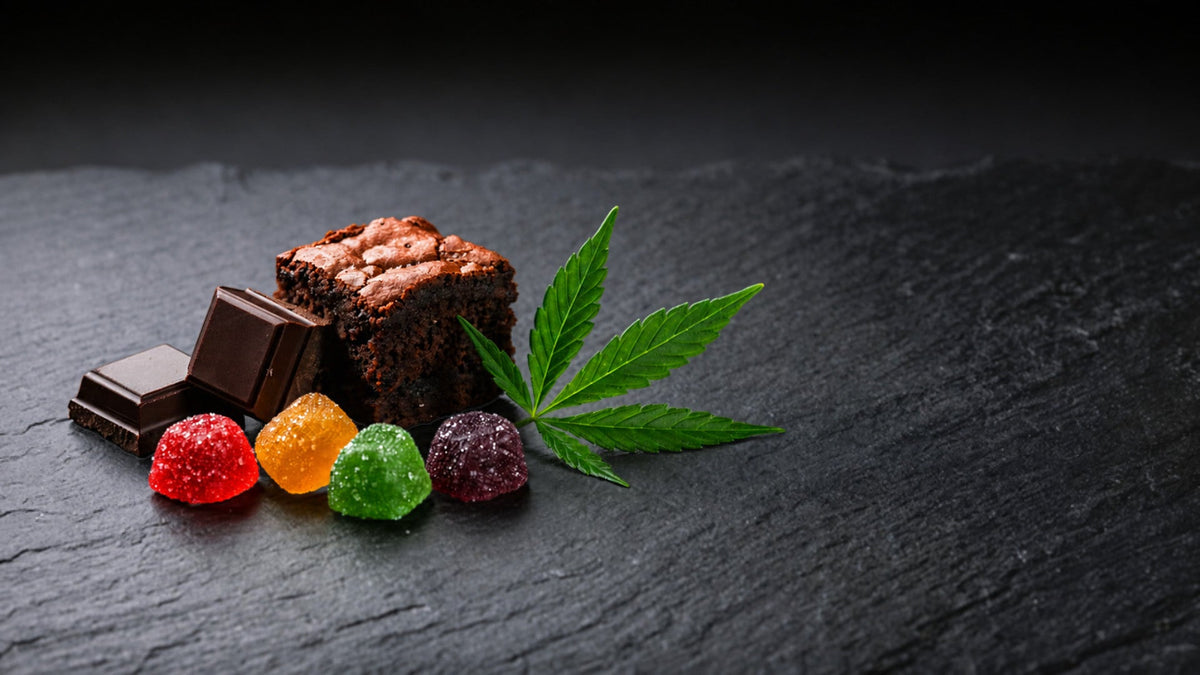
The most common formats are gummies, chocolate, cookies, brownies and hard candies, and they differ mainly in how evenly the THC can be distributed and how fast it is absorbed.
| Format | Typical portion | What to know |
|---|---|---|
| Gummies | one gummy per portion | easy to portion, the most common format |
| Chocolate | pieces or squares of a bar | fat helps to dissolve THC, the bar must be divided precisely |
| Cookies and snacks | one piece | baked, so the cannabinoid content is set before baking |
| Brownies | one piece | dense, rich, often a larger portion |
| Hard candies | one candy | dissolve slowly, part of the absorption may start in the mouth |
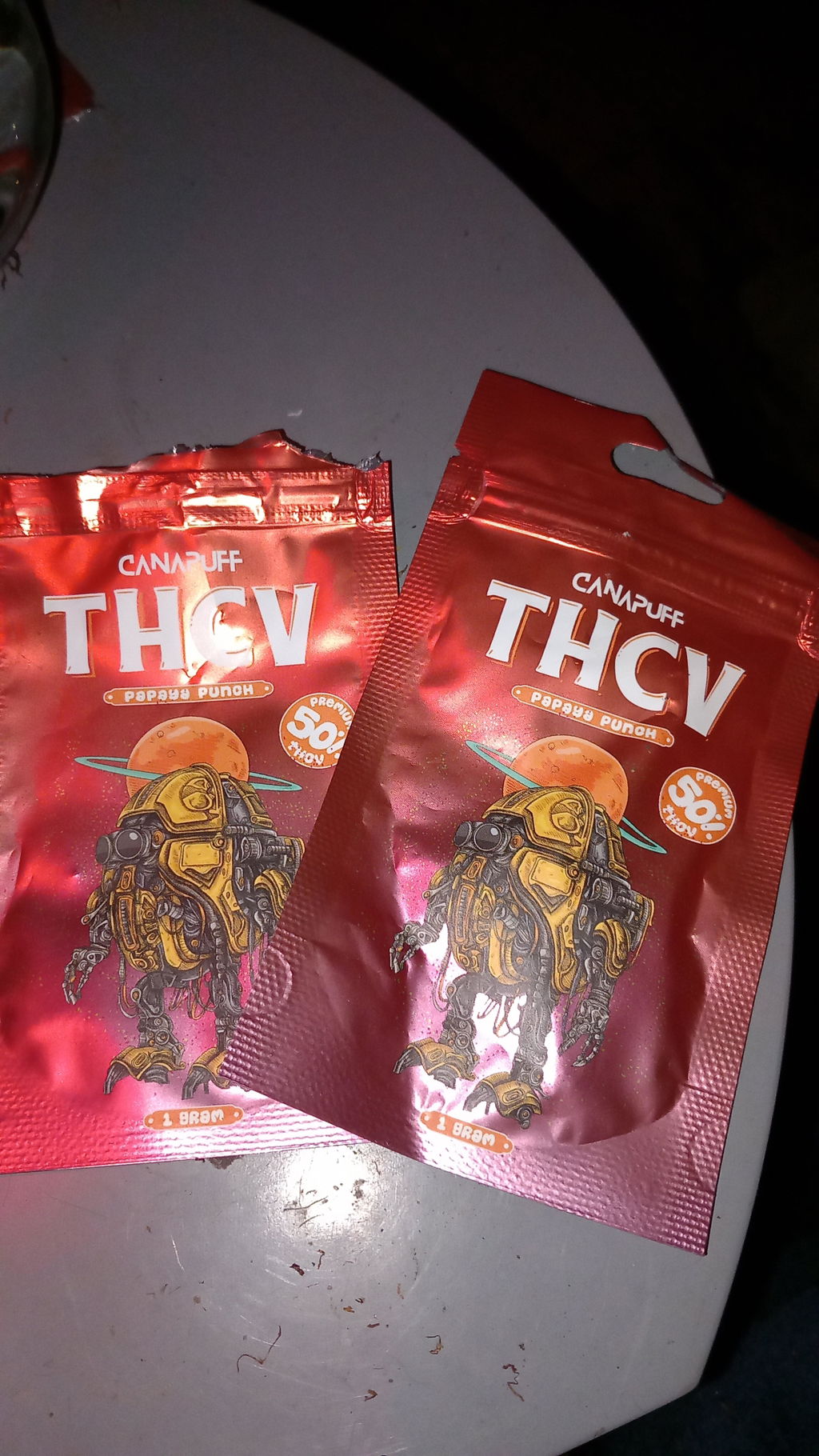
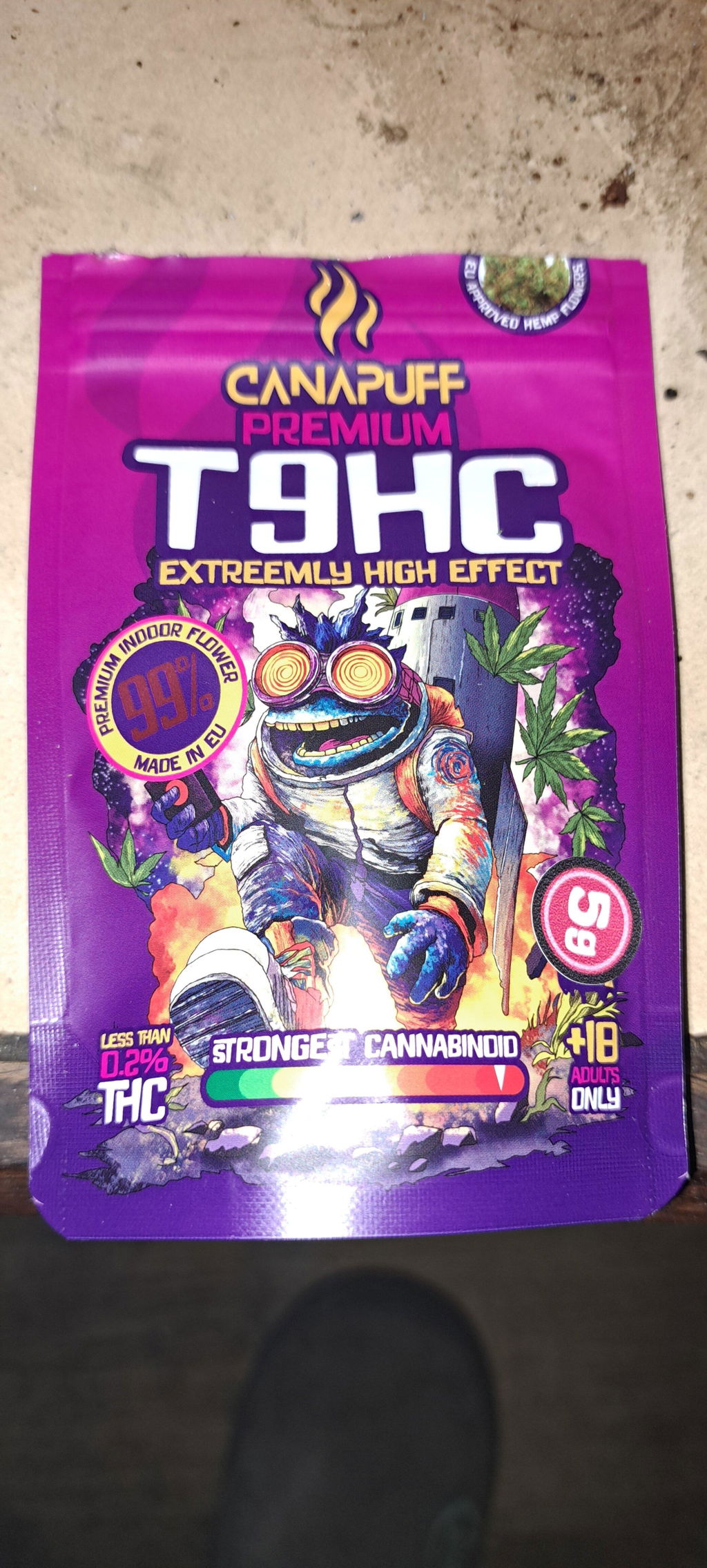
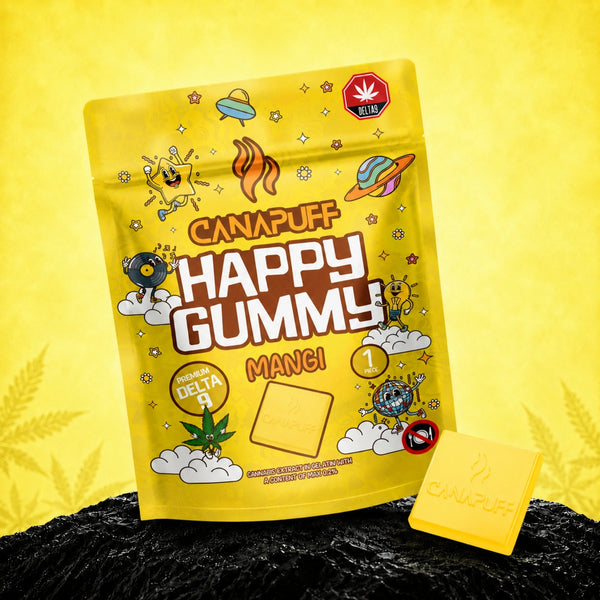
At Canapuff, the hemp-based edibles are grouped in the edibles collection: the Happy Gummy range in many flavours under Happy Edibles, plus brownies, cookies and chocolate. Each product page lists the cannabinoid content. Check it and the certificate of analysis before you buy.


How long do Delta 9 edibles take to kick in
Delta 9 edibles usually take 30 to 90 minutes before the effects begin, and the strongest phase follows after about 2 to 3 hours. In a review of THC pharmacokinetics, oral effects set in with a delay of 30 to 90 minutes and reached their maximum after 2 to 3 hours (Grotenhermen, Clinical Pharmacokinetics, 2003). In a controlled study at Johns Hopkins with brownies of 10, 25 and 50 mg THC, effects did not appear until 30 to 60 minutes after eating and peaked after 1.5 to 3 hours (Schlienz et al., Drug and Alcohol Dependence, 2020).
The delay comes from digestion. The THC first has to be released from the food, absorbed in the intestine and pass through the liver before it reaches the brain. A large part of the dose is converted on the way. This is also the most common source of unpleasant experiences: users who feel nothing after half an hour and take another portion often report that both portions start to work at the same time.
How long do Delta 9 edibles last
The effects of Delta 9 edibles last about 4 to 12 hours, clearly longer than the 2 to 3 hours after smoking. In the Johns Hopkins brownie study, effects lasted 6 to 8 hours at doses of 10 mg and more (Vandrey et al., Journal of Analytical Toxicology, 2017). Lower amounts tend toward the shorter end. Many users describe the last hours as a calm, tired phase rather than a clear high. How long a small amount such as 5 mg remains measurable in blood, saliva and urine is shown in our article how long does 5mg of THC stay in your system.

Why the effects of Delta 9 edibles vary
The same edible can feel very different from one person to the next, because absorption, liver metabolism and tolerance vary widely. Only a small share of swallowed THC reaches the bloodstream unchanged, and blood levels after edibles are much lower and more variable than after inhaling (Huestis, Chemistry and Biodiversity, 2007). A report by RTI International on cannabis edibles names the delayed onset, the uneven distribution of THC in some products and unclear labels as the main challenges of this product group (Barrus et al., RTI Press, 2016).
- Stomach contents: a meal, especially a fatty one, changes how fast and how much THC is absorbed.
- Liver metabolism: how much THC becomes 11-hydroxy-THC differs between people.
- Tolerance: regular users often notice little from an amount that is strong for occasional users.
- Body and situation: body weight, sleep, alcohol and mood change the experience.
- The product: homemade edibles in particular can contain very different amounts in each piece.
Side effects that users report include dry mouth, a faster heartbeat, dizziness and, at higher amounts, anxiety or confusion. An overview is in our article on THC gummies side effects.


Delta 9 edibles in Germany: the legal situation
THC edibles are not part of the legal framework that Germany created for cannabis in 2024, and hemp products are subject to separate limits. The most important points, as of 21 November 2026:
- KCanG: the Cannabis Act (Konsumcannabisgesetz) has applied since 1 April 2024. It allows adults limited possession and private cultivation, and non-commercial cultivation associations (KCanG, gesetze-im-internet.de).
- Edibles: according to the Federal Ministry of Health, so-called edibles with THC, such as gummies and cookies, remain prohibited. Cultivation associations may pass on cannabis only as dried flowers or resin, not mixed with food. Mail order and online sale of cannabis also remain prohibited (BMG FAQ on the Cannabis Act).
- Industrial hemp: under the KCanG, hemp counts as industrial hemp only if its THC content does not exceed 0.3 percent and its use excludes abuse for intoxication. Whether a hemp product meets this definition is judged case by case.
- Medical cannabis: prescriptions such as dronabinol are governed by the Medical Cannabis Act (MedCanG), not by the KCanG.
- EU food law: the EU sets maximum levels for THC in hemp seed foods, for example in Regulation (EU) 2023/915 (EUR-Lex). Other European countries have their own rules on THC and hemp products.
The rules change often and differ from country to country. Our article on cannabis rules in Germany describes the current situation in more detail.
Do Delta 9 edibles show up on a drug test
Yes: Delta 9 edibles contain THC, and standard drug tests detect its metabolite THC-COOH regardless of whether the THC came from a joint or a gummy. Hemp-based edibles are no exception if they contain a measurable amount of THC. How long the metabolite stays detectable depends mostly on how often a person uses THC. Detection windows and test cutoffs are explained in our guide how long does weed stay in your urine.
Last updated: 21 November 2026